Article •
Do it Dumber, Do it Faster, Do it Now
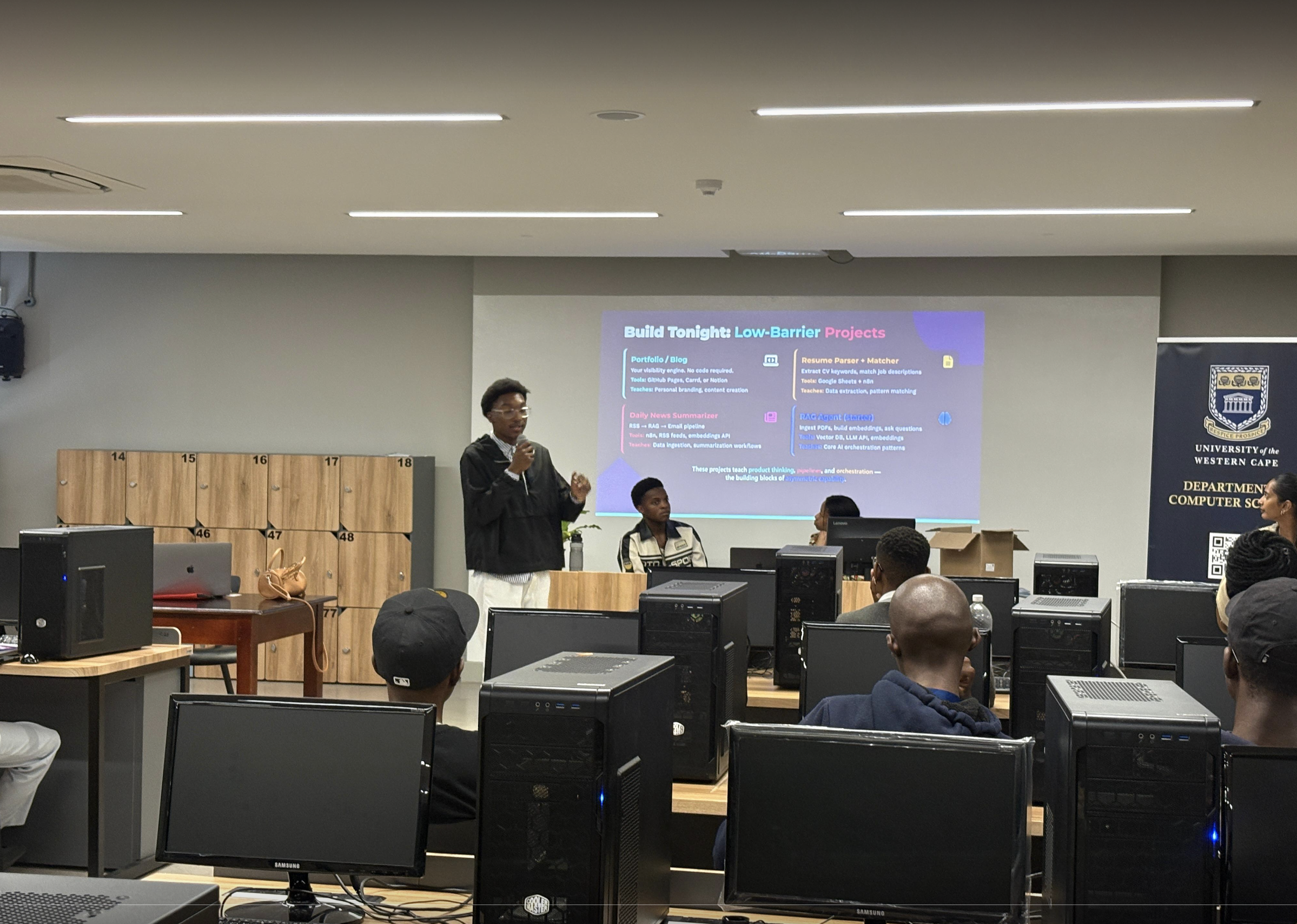
Today I had the privilege of addressing the IT Society of the University of the Western Cape on a topic that matters to every single one of us: how to position yourself in the coming AI age.
Today I had the privilege of addressing the IT Society on a topic that matters to every single one of us: how to position yourself in the coming AI age.
My core thesis is simple: asymmetric capability. The ability to achieve disproportionate results with far less effort than was previously possible.
Here’s the shift: until now, outcomes were tied to how much skill, time, and knowledge you personally invested. Years of learning. Hours of practice. Deep specialization. That’s what separated the top 1% from everyone else.
But AI is changing the equation. Intelligent systems are compressing the time and effort needed to produce outcomes. What once demanded years of mastery can now be achieved by those with less experience, if they know how to orchestrate the right tools.
This doesn’t mean skill or expertise disappear. What it means is the playing field is being re-drawn. The edge no longer belongs solely to the specialist. It belongs to the strategist, the person who knows how to leverage AI to multiply output, shorten feedback loops, and scale ideas faster than competitors.
That’s asymmetric capability: doing more with less, faster than those still playing the old game.
The opportunity here is enormous. If you lean in early, experiment boldly, and learn to integrate these tools into your work, you’ll unlock a strategic advantage that compounds over time.
The future won’t reward those who resist this shift. It will reward those who ride it.
So the challenge I leave you with is this: stop waiting until you “know enough.” Start building, testing, and iterating now. Because in this new era, it’s not about who works the hardest, it’s about who adapts the fastest.
Do it Dumber, Do it Faster, Do it Now
My core thesis is simple: asymmetric capability. The ability to achieve disproportionate results with far less effort than was previously possible.
Here’s the shift: until now, outcomes were tied to how much skill, time, and knowledge you personally invested. Years of learning. Hours of practice. Deep specialization. That’s what separated the top 1% from everyone else.
But AI is changing the equation. Intelligent systems are compressing the time and effort needed to produce outcomes. What once demanded years of mastery can now be achieved by those with less experience, if they know how to orchestrate the right tools.
This doesn’t mean skill or expertise disappear. What it means is the playing field is being re-drawn. The edge no longer belongs solely to the specialist. It belongs to the strategist, the person who knows how to leverage AI to multiply output, shorten feedback loops, and scale ideas faster than competitors.
That’s asymmetric capability: doing more with less, faster than those still playing the old game.
The opportunity here is enormous. If you lean in early, experiment boldly, and learn to integrate these tools into your work, you’ll unlock a strategic advantage that compounds over time.
The future won’t reward those who resist this shift. It will reward those who ride it.
So the challenge I leave you with is this: stop waiting until you “know enough.” Start building, testing, and iterating now. Because in this new era, it’s not about who works the hardest, it’s about who adapts the fastest.
Do it Dumber, Do it Faster, Do it Now